


Good News or Bad News? Learn Essential French Vocabulary for Sharing News
Every day, we hear news. Sometimes it is exciting, sometimes unexpected, and sometimes disappointing. Whether someone gets a new job, announces a wedding, or shares unfortunate news, knowing how to talk about these situations is an important part of speaking natural French.
In this episode of Fourmi Talks, we explore the vocabulary and expressions French speakers use when announcing, receiving, and reacting to news. You will also learn a common grammar mistake, two useful idiomatic expressions, and practical sentences you can start using immediately.
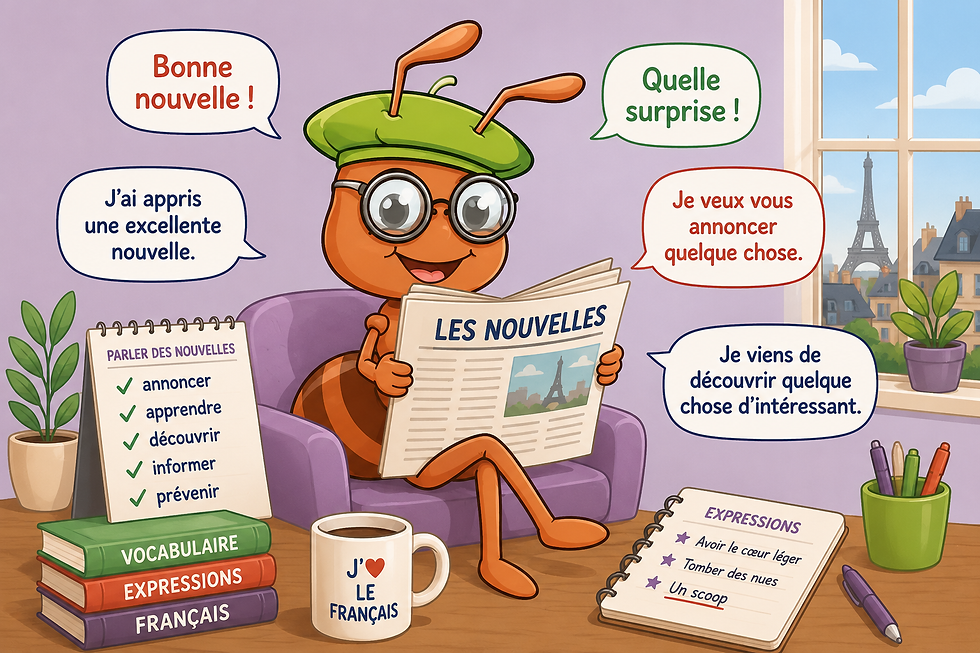
Essential French verbs for talking about news
When discussing the news, several verbs appear frequently in everyday conversations.
Annoncer
The verb annoncer means to announce or to share important information.
Examples:
Elle a annoncé son mariage à sa famille.
Le président a annoncé une nouvelle mesure.
J'ai une bonne nouvelle à vous annoncer.
Apprendre
Apprendre means to learn or to find out information for the first time.
Examples:
J'ai appris une excellente nouvelle.
J'ai appris qu'il avait trouvé un nouvel emploi.
Nous avons appris la nouvelle hier soir.
Découvrir
Découvrir means to discover something or to learn something previously unknown.
Examples:
J'ai découvert un nouveau restaurant.
Elle a découvert la vérité.
Nous avons découvert un problème dans le système.
Informer
The verb informer is more formal and is commonly used in professional, medical, or administrative situations.
Examples:
Je vous informe que la réunion est annulée.
Le médecin a informé le patient des résultats.
Nous avons été informés du changement.
Prévenir
Prévenir means to warn, to notify, or to let someone know in advance.
Examples:
Merci de me prévenir si vous êtes en retard.
Elle m'a prévenu du problème.
Il faut prévenir les clients à l'avance.
Understanding the difference between these verbs will help you choose the most natural word depending on the situation.
Two French expressions you should know
French is full of colorful expressions that make conversations sound more authentic.
Avoir le cœur léger
Literally meaning to have a light heart, this expression means to feel relieved, happy, or free from worry.
Examples:
Après avoir reçu la bonne nouvelle, j'avais le cœur léger.
Elle est partie en vacances avec le cœur léger.
Tomber des nues
This expression literally means to fall from the clouds, but it actually means to be completely shocked or surprised.
Example:
Quand j'ai appris qu'il avait gagné, je suis tombé des nues.
This is a very common expression that native French speakers use when they receive surprising news.
Useful French sentences for everyday conversations
Here are some practical phrases you can use whenever you need to announce or react to news.
J'ai une bonne nouvelle à vous annoncer.
J'ai une mauvaise nouvelle à vous annoncer.
Je viens d'apprendre quelque chose.
Je voulais vous prévenir d'un changement.
Je viens de découvrir quelque chose d'intéressant.
Je n'arrive pas à y croire !
C'est une surprise totale.
Quelle excellente nouvelle !
Try using these expressions in your own conversations to become more confident speaking French.
Practice your French with a short dictation
One of the best ways to improve your listening and spelling is through short dictations.
Try writing this paragraph while listening to the podcast.
Ce matin, j'ai appris une bonne nouvelle. Mon ami m'a annoncé qu'il avait trouvé un nouveau travail. J'étais très heureux pour lui et j'avais le cœur léger.
Afterward, compare your version with the original and listen again if necessary. Repetition is one of the fastest ways to remember new vocabulary.
Keep building your French vocabulary
Talking about news is something we all do every day. Learning verbs such as annoncer, apprendre, découvrir, informer, and prévenir will help you express yourself more naturally in French.
If you would like to practise these words in real conversations, join one of our online conversation workshops at Fourmi Languages. Speaking regularly with other learners is one of the most effective ways to build confidence and make new vocabulary become part of your everyday French.


Comments